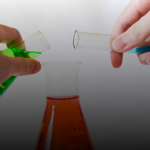
bubbles, color change, production of a solid, heat that is produced or absorbed
Back
oxidation-reduction reaction
Front
electrons are transferred from one substance to another
Back
avogradro's number
Front
6.02 x 10^23
Back
trigonal planar geometry
Front
120 degrees
Back
ion dipole forces
Front
- relatively stron electro static attractions between ions and polar molecules
- causes the dissolution of the ionic solids in polar solvents such as water
Back
combination (synthesis) reactions
Front
-two or more elements form one product
- simple compounds combine to form one product
Back
molar mass
Front
- the mass of 1 mole of an element
- the average atomic mass expressed in grams
Back
the delta sign signifies...
Front
heat
Back
Linear geometry
Front
180 degrees
Back
To write a chemical reaction
Front
reactant 1 + reactant 2--> product 1 + product 2
starting material vs finishing material
Back
polar covalent bonds
Front
non metal atoms, unequal sharing of electrons, moderate electronegativity
Back
molar mass conversion factors
Front
- are fractions ( ratios) written from the molar mass
- relate grams and moles of an element or compound
Back
diatomic molecules
Front
H2, N2, O2, F2, Cl2, Br2, I2
Back
polar molecules
Front
electrons shared unequally
Back
OIL RIG
Front
Oxidation
Is
Loss of Electrons
Reduction
Is
Gain
Electrons
Back
1 mole
Front
6.02 x 10^23
Back
equal bond electron sharing
Front
nonpolar bond unequal sharing of electrons = polar bond
Back
electronegativity
Front
of an atom is it's ability to attract the shared electrons in a bond
- increases from left to right ( bottom to top)
- low for metals
- high for non metals
Back
non polar covalent bonds
Front
2 non metals, equal sharing, small electronegativity
Back
electronegativity numbers
Front
0-0.4 --> non polar
0.5-1.8--> polar
greater than 1.8-> ionic
Back
single replacement reaction
Front
one element takes the place of a different element in another reacting compound
Back
double replacement reaction
Front
both ions in the reactant compounds switch places
Back
chemical reaction
Front
occurs when a substance is converted into one or more substances with different formulas and different properties
Back
subscripts in a formula
Front
- show the relationship of atoms in the formula
- the moles of each element in 1 mole of a compound
Back
decomposition reaction
Front
- one substance splits ( or decomposes) into two or more simpler substances
Back
in a balanced equation
Front
- no atoms are lost or created ( conservation of matter)
- the number of atoms on the reactant side is equal to the number of atoms on the product side
Back
VSEPR theory
Front
-describes the orientation of electron groups around the central atom
- states that electron groups are arranged as far apart as possible around the central atom to minimize the repulsion between them
- states that the specific shape of a molecule is determined by the number of atoms attached to the central atom
Back
double bond
Front
atoms share 2 pairs of electrons
Back
combustion reaction
Front
- carbon- hydrogen containing compound burns in oxygen gas to form carbon dioxide ( CO2) and water (H2O)
- energy is released as a product in the form of heat
Back
tetrahedral geometry
Front
109 degrees
Back
non polar molecules
Front
bonding electrons are equally attracted to both bonded atoms